
And so the Adventure Begins
I was a weird kid. I installed Linux on my first real desktop. After hearing on IRC about how useful Unix “shell accounts” are, I get my first taste of a “real” Unix system through the public shell service at sdf.org , which is still operating today. Thanks to them, I’m able to log into a Sun Microsystems server running the Solaris operating system. There is a feeling of arcane power that I don’t get from using Linux, then still a scrappy underdog. I proceed to search eBay for Sun workstations. A listing for like $100 appears for a SPARCstation IPX , a “lunchbox” system made by Sun in 1991. Incredibly, it even comes with an original monitor, keyboard, and that annoying early optical mouse with a metal mousepad.
UPS drops off a big box a couple weeks later, and I unpack it eagerly. Everything is in great shape. I peek inside the chassis, which, like a lunchbox, means lifting the top half of the case. There’s a drawing of a cat silkscreened on the motherboard . I plug in the cables and turn it on. Instead of the black screen with blocky white text that I’m used to from the PC world, there’s a white background with a colourful 3D render of the Sun logo , and black text in a fancy font (it has serifs!) scrolling up the screen. The hard drive boots into Solaris 7, and it seems the previous owner has named the system gandalf. I am able to update it to the IPv6 Prototype for Solaris and access the newfangled IPv6 Internet over a tunnel, as was the fashion at the time.
Corollary: Unix on the Desktop
It was the heyday of sites like themes.org . The Fluxbox window manager had recently forked off of Blackbox. A kid named artwiz was the making waves in the burgeoning uh, Unix desktop enthusiast community? Man, I wanted to be like him. The SPARCstation IPX ran Blackbox with some of his themes and fonts , which looked cool as hell in 8-bit colour. I would drop in on online friends on IRC using the ircII/EPIC client.
The SPARCstation LX
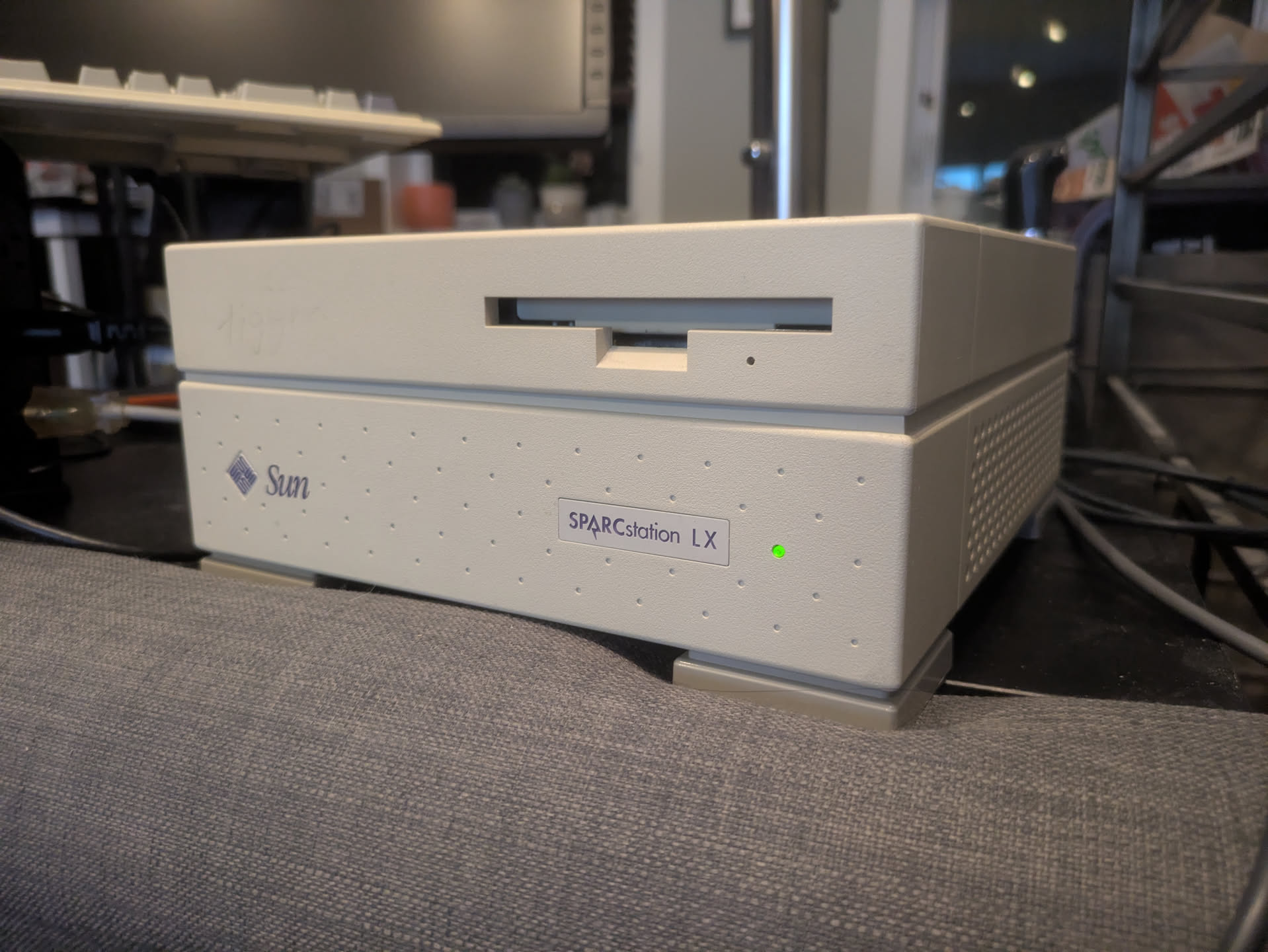
Many years pass. I start working in the software industry. Many of my colleagues are exiles from Sun. While I’m visiting a coworker, he gives me his old SPARCstation LX , which I assume he had used back in the day at the Sun office in Burlington. It packs a low-power 50 MHz microSPARC CPU in a lunchbox chassis, like the IPX from my childhood. It’s one of the last lunchbox workstations that Sun would release in 1992, and sort of stretched the form factor by extending the rear ports down into the rear “feet”. The LX survives two cross-country moves with me and languishes in a dusty corner of the server closet in my condo, wrapped in tattered brown paper like an old mummy. Scrawled above the Sun logo on the case with a pencil is the word tigger, which I presume to be its name.
Present Day… Present Time
Fast forward to the spring of 2026. I’m reading about a device called a BlueSCSI that replaces old parallel SCSI drives with an SD card. I know I’ll need one of these SCSI emulators if I ever decide to take on the project of reviving the SPARCstation LX, since its hard drive hadn’t been powered on for at least two decades. I find another device named ZuluSCSI, which offers blazing fast 10MB/s speeds over a Wide SCSI connection. A lore drop informs me about beef between the developers of the two devices. I locate a ZuluSCSI Blaster for like $40, again on eBay. A few months after that, I decide to free the LX from its paper sarcophagus.
Power
I want to see if the power supply is still good, and to power its hard drive so I can back it up with the ZuluSCSI. I crack the LX open to expose the insides, and plug a power cord into the socket. I flick the spring-loaded rocker switch on the back. The fan whirs to life, but I’m immediately greated with a loud snap! as a bright red flare erupts from a corner of the motherboard. I quickly yank the power to the system, but the most foul-smelling smoke forces me to leave the room.
To be continued…